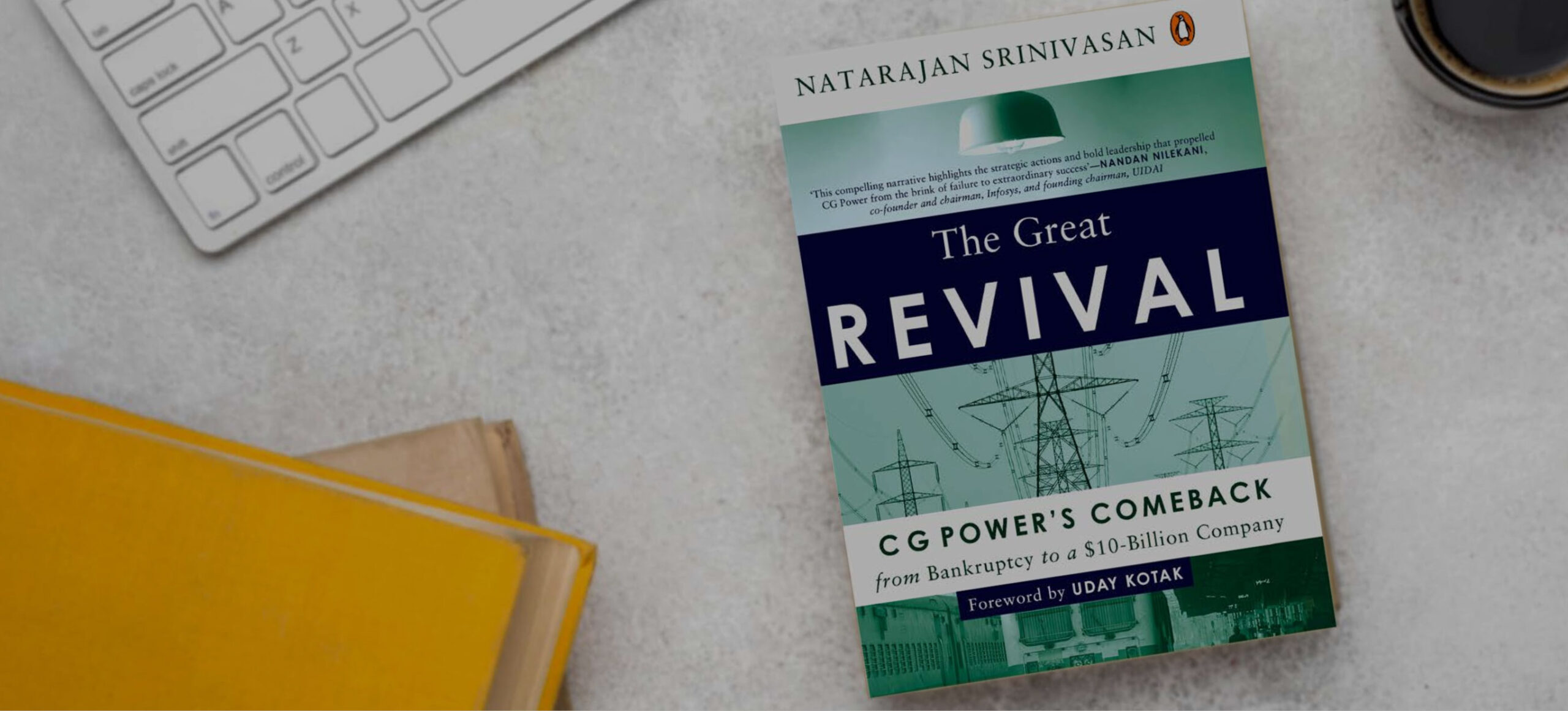
The Great Revival
CG Power’s
Comeback Story
From Bankruptcy To
A $ 10 bn Company
BY NATARAJAN SRINIVASAN
GET YOUR COPY OF ‘THE GREAT REVIVAL’


This compelling narrative highlights the strategic actions and bold leadership that propelled CG Power from the brink of failure to extraordinary success’
Nandan Nilekani, co-founder and chairman, Infosys, and founding chairman, UIDAI
The Author
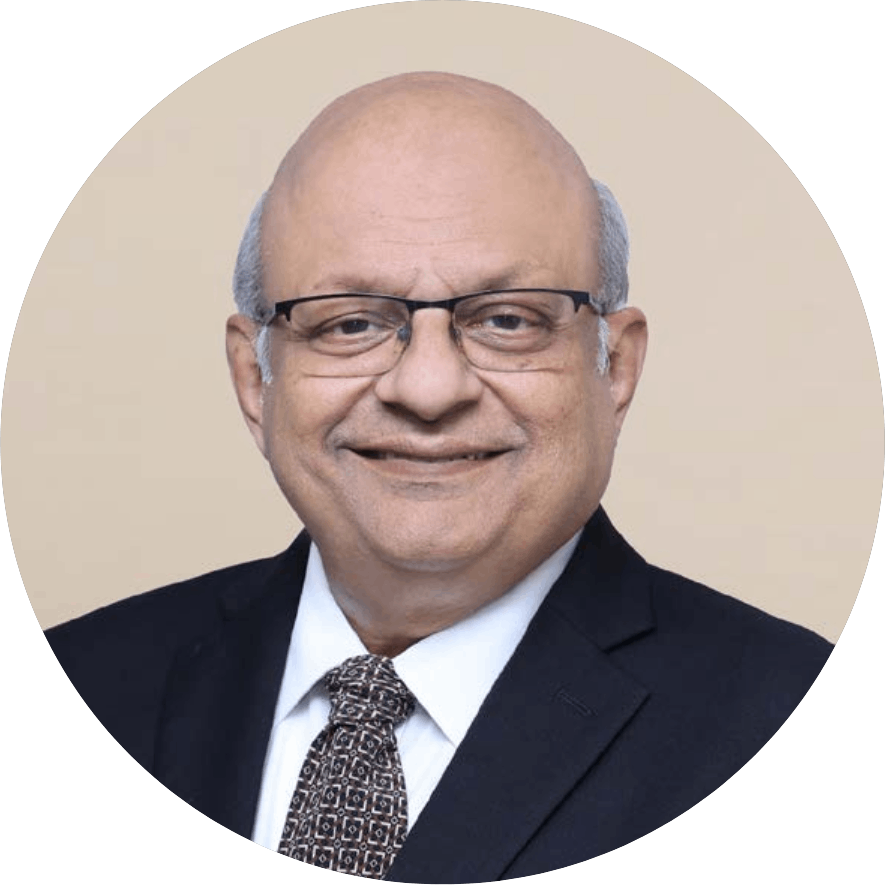
Natarajan Srinivasan
Natarajan Srinivasan is the turnaround specialist who rewrote India’s corporate recovery playbook.
Now Executive Vice Chairman of Coromandel International Limited (following his stint as the Managing Director of CG Power), is widely regarded as one of India’s foremost turnaround specialists — a leader who has rescued, rebuilt, and redefined organisations across sectors.
A commerce graduate and member of both the Institute of Chartered Accountants of India (ICAI) and the Institute of Company Secretaries of India (ICSI), Srinivasan’s 40-year career spans an experience of having worked in engineering, finance, infrastructure, and manufacturing companies.
Srinivasan began his career at Bharat Heavy Electricals Limited (BHEL), gaining early exposure to the rigour of large-scale engineering management, before joining the Murugappa Group in 2004. Over two decades, he served as Chief Financial Officer of Carborundum Universal Ltd., Group Finance Director and Director on the Murugappa Corporate Board, and later as Vice Chairman and Managing Director of Cholamandalam Investment and Finance Company Ltd.
Natarajan Srinivasan is the turnaround specialist who rewrote India’s corporate recovery playbook.
Now Executive Vice Chairman of Coromandel International Limited (following his stint as the Managing Director of CG Power), is widely regarded as one of India’s foremost turnaround specialists — a leader who has rescued, rebuilt, and redefined organisations across sectors.
A commerce graduate and member of both the Institute of Chartered Accountants of India (ICAI) and the Institute of Company Secretaries of India (ICSI), Srinivasan’s 40-year career spans an experience of having worked in engineering, finance, infrastructure, and manufacturing companies.
Srinivasan began his career at Bharat Heavy Electricals Limited (BHEL), gaining early exposure to the rigour of large-scale engineering management, before joining the Murugappa Group in 2004. Over two decades, he served as Chief Financial Officer of Carborundum Universal Ltd., Group Finance Director and Director on the Murugappa Corporate Board, and later as Vice Chairman and Managing Director of Cholamandalam Investment and Finance Company Ltd.
At Cholamandalam, he led one of India’s most remarkable NBFC revivals, steering the company out of the 2008 credit crisis, restructuring its lending model, and regaining profitability and investor trust. His calm crisis navigation made him the Government of India’s natural choice for appointment to the IL&FS Board in 2018, where he contributed to restoring governance and stability at the country’s largest distressed infrastructure financier through recovery efforts, assistance in recasting the accounts and assets restructuring.
In 2020, he took charge as MD & CEO of CG Power and Industrial Solutions Ltd., guiding the company from near bankruptcy to a twentyfold market-cap surge within four years — a feat that redefined corporate revival in India.
Recipient of the Transformative Leader of the Year (2024) and Financial Express Lifetime Achievement Award (2025), Srinivasan exemplifies ethical capitalism, disciplined governance, and the conviction that businesses, like people, deserve second chances — if led with clarity and conscience.
The target audience for this book

Management
Students

Business
managers

Market
analysts

Finance
professionals

Media
professionals

Corporate
historians
The Great Revival is a landmark Indian business story – a testament to ethics-driven leadership and disciplined execution. The book is positioned as a case study and an inspirational blueprint for turnaround management that will resonate with professionals, students, and investors alike.
Endorsements
Stakeholder perspectives
Vellayan Subbiah, Chairman, CG Power
“Possibly the biggest factor in the way the turnaround unfolded was the Managing Director N. Srinivasan. My father and I asked NS whether he would take on the role of leading CG and he accepted. NS had been the Lead Director of Cholamandalam Finance with me (where I reported to him) and had played a significant role in growing that company. ‘NS’ was just the person for this new role; he was a karmayogi engaged non-stop and respite-less in the turnaround from day one with the intensity that comes rarely. He possessed three
Vellayan Subbiah, Chairman, CG Power
“Possibly the biggest factor in the way the turnaround unfolded was the Managing Director N. Srinivasan. My father and I asked NS whether he would take on the role of leading CG and he accepted. NS had been the Lead Director of Cholamandalam Finance with me (where I reported to him) and had played a significant role in growing that company. ‘NS’ was just the person for this new role; he was a karmayogi engaged non-stop and respite-less in the turnaround from day one with the intensity that comes rarely. He possessed three capabilities – sound financial understanding, deep legal insight and business management competence.”
Susheel Todi, Chief Financial Officer
“The unity of the senior management team (proved to be a lifeline). There was a sense of unity among the senior managers. They were bound by a common purpose: a commitment to clear their name, a commitment to turn around a company that had been good to them and a commitment to play a heroic role in the otherwise humdrum of existence. Lastly, there was an institutionalised memory that the company had overcome an existence challenge at the turn of the century, so there was, despite the challenges – less
Susheel Todi, Chief Financial Officer
“The unity of the senior management team (proved to be a lifeline). There was a sense of unity among the senior managers. They were bound by a common purpose: a commitment to clear their name, a commitment to turn around a company that had been good to them and a commitment to play a heroic role in the otherwise humdrum of existence. Lastly, there was an institutionalised memory that the company had overcome an existence challenge at the turn of the century, so there was, despite the challenges – less and less cash to go around – an underlying optimism that this could be replicated.”
Ramesh Kumar N., President of the Motors and Drives business
“The worst of times brought out the best in our business. Following the induction of the Murugappa Group, the business recognised that there was now a need not only to catch up on lost market share but to deepen business competitiveness. The new management launched two projects; Project Mudra with McKinsey was directed to strengthen the supply chain; Project Lean was directed to enhance operational leanness, which comprised the need to derive more from less (people, working capital, and space)
Ramesh Kumar N., President of the Motors and Drives business
“The worst of times brought out the best in our business. Following the induction of the Murugappa Group, the business recognised that there was now a need not only to catch up on lost market share but to deepen business competitiveness. The new management launched two projects; Project Mudra with McKinsey was directed to strengthen the supply chain; Project Lean was directed to enhance operational leanness, which comprised the need to derive more from less (people, working capital, and space) without significant capital expenditure…This brings me to the moral of the story: This turnaround was not the victory of government (day to day management); it was the victory of governance, which comprised the capacity to do the right things at the right time in the right way.”
Mukul Shrivastava, President, Power Systems (Switchgears and Transformers)
“…every single day, the CG Power executives would be besieged by calls from vendors who had not been paid for months. Some calls would be polite and sympathetic; others would be irate. One said: ‘I will come and commit suicide at your office gate and then you will see the fun!’ Another said: ‘Saab, my child asked me for tea this morning and all I could afford was milk.’ The CG Power executives who fielded vendors started turning into shock absorbers. Our job was
Mukul Shrivastava, President, Power Systems (Switchgears and Transformers)
“…every single day, the CG Power executives would be besieged by calls from vendors who had not been paid for months. Some calls would be polite and sympathetic; others would be irate. One said: ‘I will come and commit suicide at your office gate and then you will see the fun!’ Another said: ‘Saab, my child asked me for tea this morning and all I could afford was milk.’ The CG Power executives who fielded vendors started turning into shock absorbers. Our job was not to counter and retaliate; our job was to listen, listen and listen.”
A prominent investor in CG Power
“NS Srinivasan was the ideal complement to Vellayan. He understood the financials; he understood how the market valued companies; he could dive into the fine print of legal paper; he was someone who would be found working at 4am; his integrity was beyond question as he monetised the company’s non-core assets that would otherwise have been sold for a song. On top of this, he ensured that every single business was returned to competitive health. He played the role of a classic quasi-entrepreneur; he used a combination
A prominent investor in CG Power
“NS Srinivasan was the ideal complement to Vellayan. He understood the financials; he understood how the market valued companies; he could dive into the fine print of legal paper; he was someone who would be found working at 4am; his integrity was beyond question as he monetised the company’s non-core assets that would otherwise have been sold for a song. On top of this, he ensured that every single business was returned to competitive health. He played the role of a classic quasi-entrepreneur; he used a combination of saam-daam-dand-bhed (all resources) to bring the company back on rails; he was sarva-gun-sampann. The turnaround happened because we trusted our conviction that people with values would be best placed to enhance value.”
Dinesh Khara, former Chairman, State Bank of India
“In the Murugappa Group we found a buyer with a respect for capital efficiency. The Group’s managerial bandwidth was complemented with a strategic clarity, prioritised problem solving and decision-making speed. The result was that CG Power began turning around from the first day it was acquired; the results however showed in the first quarter of the Murugappa Group’s management control, when the company turned around in financial terms. The role of State Bank of India in the turnaround of CG Power was among the
Dinesh Khara, former Chairman, State Bank of India
“In the Murugappa Group we found a buyer with a respect for capital efficiency. The Group’s managerial bandwidth was complemented with a strategic clarity, prioritised problem solving and decision-making speed. The result was that CG Power began turning around from the first day it was acquired; the results however showed in the first quarter of the Murugappa Group’s management control, when the company turned around in financial terms. The role of State Bank of India in the turnaround of CG Power was among the highlights of my professional career.”